History
An older Bali
The Lempuyang temple complex is one of the oldest in Bali - older than the 11th-century reorganisation by Empu Kuturan that shaped most of the island’s sacred geography, and quite possibly older than Hindu Bali itself. Mount Lempuyang was already considered sacred by the pre-Hindu communities who lived on its slopes, and the chain of temples climbing its ridge probably grew out of an even older tradition of mountain worship.
In its current form the complex is dedicated to Hyang Iswara, one of the four supreme manifestations of Sang Hyang Widhi - the god of the eastern direction, the rising sun, and renewal. Lempuyang faces the dawn, and on a clear morning the silhouette of Mount Agung and the Lombok Strait spread out below the temple gates in one of the most striking views on the island.
The eastern pillar
Lempuyang is the easternmost of Bali’s six sad kahyangan - the spiritual pillars that anchor the island. The others sit at Besakih (the mother temple, on the slopes of Mount Agung), Uluwatu (the south-western cliff), Goa Lawah, Pusering Jagat, and Pura Luhur Batukaru. Together they form a sacred map: each anchors a direction, and Lempuyang guards Bali from the spirits of the dawn.
Culture & context
The seven temples up the mountain
A full pilgrimage to Lempuyang isn’t a single visit but a climb. The complex consists of seven temples (eleven, in some traditions) staggered up the slopes of Mount Lempuyang, each more sacred than the last. The lowest - Pura Penataran Agung Lempuyang - is the one most visitors see; it’s where the famous split gate stands. The highest is Pura Lempuyang Luhur, at the summit around 1,058 metres, reached by roughly 1,700 stone steps and a couple of hours of climbing.
Pilgrims traditionally fast and meditate at each temple in turn on the way up, building purification stage by stage. For most tourists, the journey ends at the bottom gate; for the devout, that’s where it begins.
The Gates of Heaven
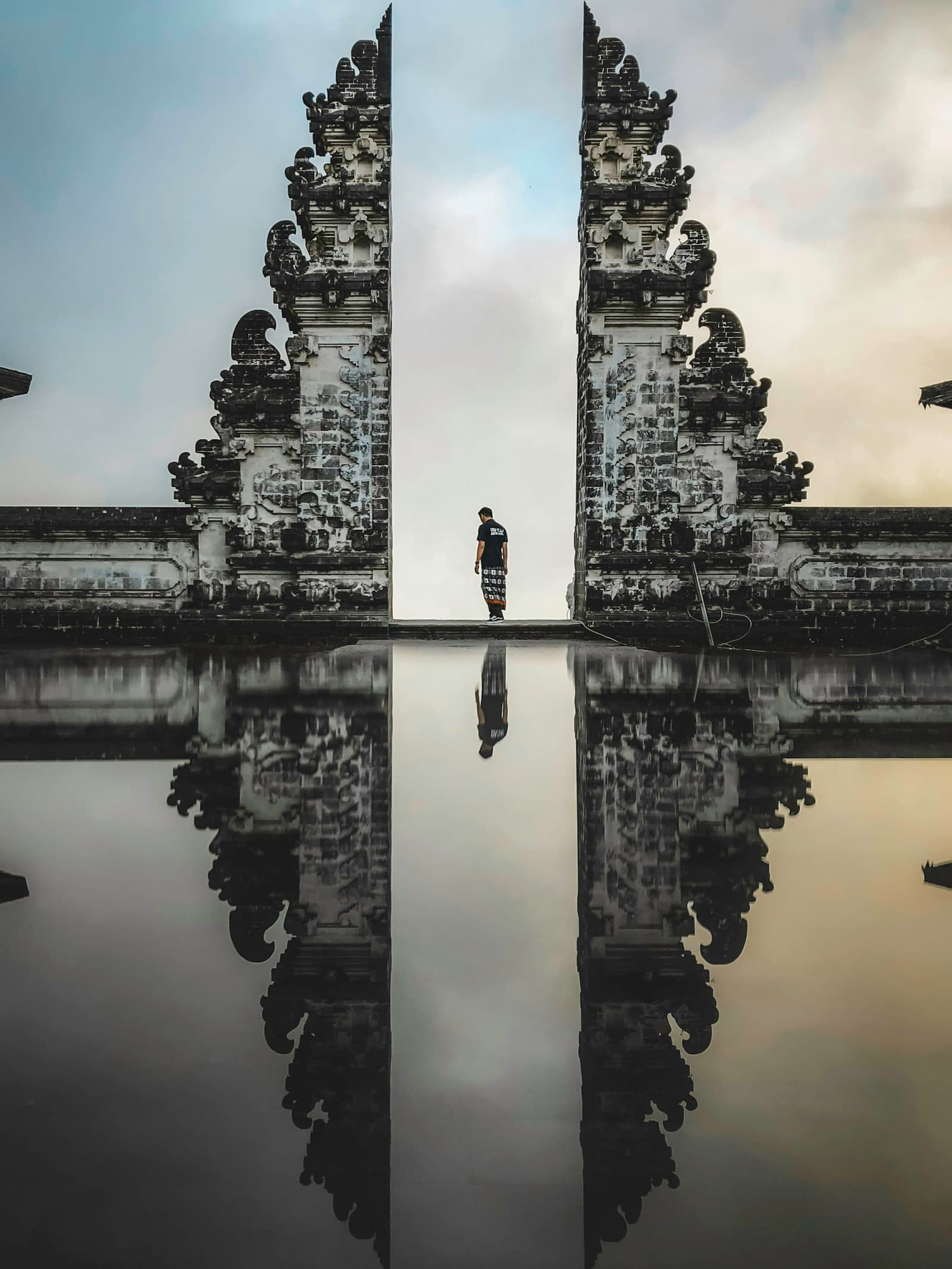
The split gate - the candi bentar - at Pura Penataran Agung frames Mount Agung perfectly when the volcano is visible. It is genuinely one of the most striking sights on the island, and over the last decade it has become one of the most photographed: the so-called Gates of Heaven of social media.
A word about that photo. The shimmering reflection pool you see in the viral shots is not a real pool - it’s a small handheld mirror or piece of glass that the on-site photographer holds beneath the lens to fake the effect. Most visitors don’t realise this until they queue, take the photo, and look down to find dry stone where the water seemed to be. The trick is a fine souvenir; the temple is also beautiful without it.
Myths & legends
The path of Markandeya
Local tradition associates the temple complex with Rsi Markandeya, the same Javanese sage credited with the early settlement of central Bali and honoured at Pura Gunung Lebah in Ubud. The seven temples up the mountain are said to mark the places where Markandeya paused to meditate on his pilgrimage, each station a moment of spiritual purification on the climb. Whether the story is literal or symbolic, it places Lempuyang inside the same ancient network of sacred routes that shaped Balinese Hindu geography.
What to see
- The Gates of Heaven at Pura Penataran Agung - the split gate framing Mount Agung on a clear morning
- The view east from the temple platform - across the Lombok Strait towards the rising sun
- The optional summit hike to Pura Lempuyang Luhur (~1,058m) - roughly four hours round trip for the devout or the determined
- Tirta Gangga water palace on the drive back - a beautifully manicured royal garden 45 minutes away
- Cool mountain air, far from the south-Bali heat
Good to know
- Arrive at sunrise for the clearest Mount Agung view and the shortest queue. By 10am the wait for the photo can stretch beyond an hour.
- Manage expectations on the photo - the reflection is a mirror trick by the on-site photographer. The temple itself is the real reason to come.
- Modest dress required - sarongs provided at the entrance. Entry around IDR 75,000, plus a small donation for the photo if you take it.
- The summit climb requires real fitness and good shoes. If you don’t plan to hike all the way up, the lower temple alone is worth the drive.
- Combine with Tirta Gangga or Taman Ujung water palace, or a Mount Agung viewpoint stop - the east is a full-day excursion from south Bali.
Last updated
Interested in visiting Lempuyang?